Monday, January 31, 2005

The Media & Entertainment Stream


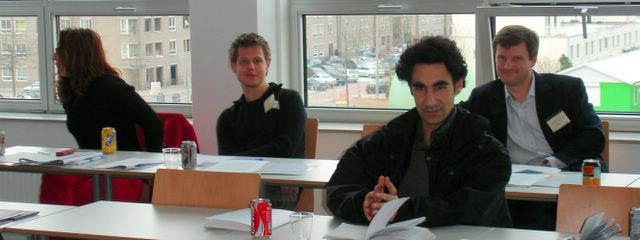
Media & Entertainment 2 Posted by Hello

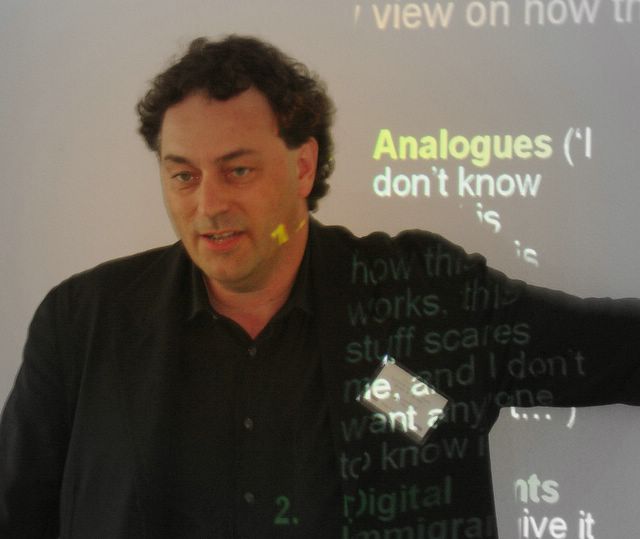
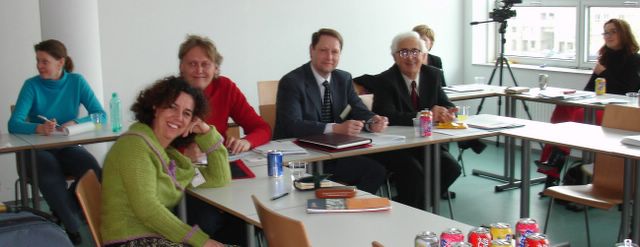
Just before we got started Wednesday afternoon (Jan 26th) at the Summit of the Future, I took a shot of those coming into the session. We had a great time exploring the future, with excellent presentations from Paul Kafno, Helen Shaw, Wim van de Donk and Gerd Leonard.

Media & Entertainment 1 Posted by Hello

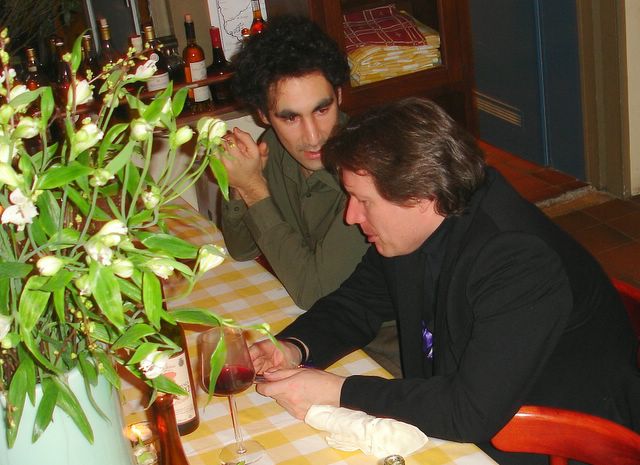
Restaurant Marius


 Posted by Hello

Restaurant Marius is a great Italian that deserves to be discovered by more people. It is at Barentszstraat 243 in Amsterdam 1013 NM. Eat there with friends and was amazed at the variety of the menu...and healthy too.

James discusses the demise of MIT Europe with Simon Jones, ex MD Posted by Hello

Glen Hiemstra


Glen Hiemstra Posted by Hello

I met Glen at the Summit for the Future in Amsterdam. He's a great personality and someone who knows how to formulate the right questions - and has suggestions for looking for the right answers. Check out his stuff here. I particularly like his Portal to the Future.

Wendy on the boat Posted by Hello

Vish at the Summit Posted by Hello

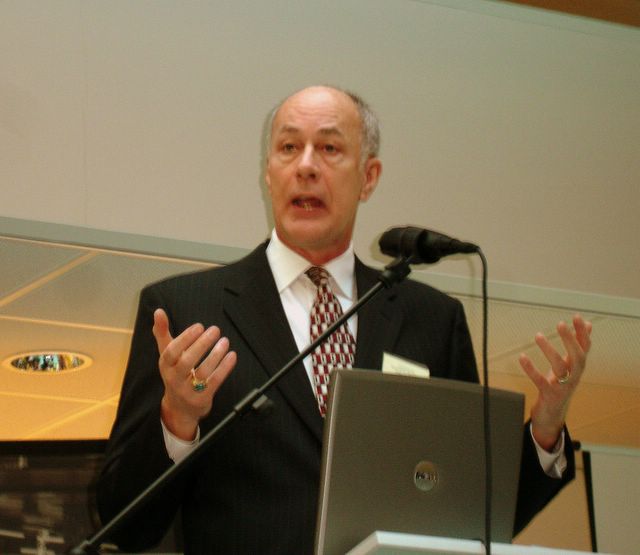
Gerd Leonard in Full Flow


Gerd Leonard - he gets it! Posted by Hello

Gerd is a musician. He is also a futurist and just a really nice guy. I think he is a leading light when it comes to thinking about the future of the music industry. He also believes in the idea of sharing ideas for free - and making the money when people want something specially tailored to their needs. Check out his website or read his paper given at the Club of Amsterdam Summit of the Future. Some interesting stats can be found here too.

Tom Lambert on Land


;Posted by Hello
Tom is Chief Executive, Centre for Consulting Excellence and Professor of Consultancy, Rushmore University UK/USA


Known to the American business press as the "world's friendliest guru" Tom Lambert is an international author, broadcaster, consultant, trainer, conference speaker, businessman and business journalist. In Europe, America and Southern Africa his books and seminars have led him to be known to the quality business press as "the consultant's consultant". .

Tom is CEO of the international Centre for Consulting Excellence (CfCE) a professional body launched by leading academics and businesspeople in the UK, USA and Australia with links to the ASEAN Region, Middle East and the EU. The CfCE is an organisation that works with business and academia to ensure the highest standards of consulting and interim management - and fee income that makes those standards essential - are sustained in a highly volatile and competitive business environment.

Tom Lambert at Summit of the Future last week Posted by Hello

Thursday, January 20, 2005

Tsunami Help Portal for broadcasters

I am coordinating a group of volunteers to organise an overview of how various organisations around the world have reacted to help broadcasters affected by the December 26th Earthquake and Tsunami. We all share the belief that by sharing this information on a new portal, that broadcasters will be stimulated to coordinate their efforts.

Check it out....

Tuesday, January 18, 2005

EBU in the dark


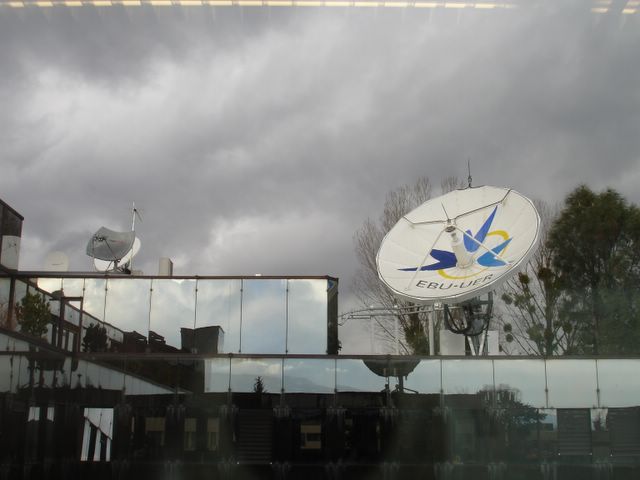
In Geneva when all the power went off at the European Broadcasting Union. Suddenly Powerpoint doesn't look so good! Posted by Hello

Saturday, January 15, 2005

Challenge Coming for Shortwave

4 January 2005, New Scientist
Author Barry Fox

After the tsunami hit Sri Lanka on 26 December, Victor Goonetilleke, head of the island's amateur radio society, delivered a short-wave radio set and two 12-volt car batteries to the prime minister's emergency headquarters in Colombo. At the same time, three of his friends drove through the devastation to Hambantota, on the hard-hit south-east coast, where they set up another battery-powered short-wave radio.

For two days, while the military struggled to restore electricity supplies and phone lines, the prime minister was able to use the short-wave link to talk to staff on the ground. Short-wave signals from Sri Lanka, the Andaman Islands and mainland India also helped to spread news of the disaster around the world. The same happened after the 9/11 attacks and last year's hurricanes in the Caribbean.
When phones and mains electricity are down, making the internet unusable, short-wave radio enthusiasts are able to maintain emergency communications.

But not, perhaps, for much longer. Plans to deliver broadband internet signals to homes and businesses down mains electricity cables, rather than telephone lines, could cause interference that will drown out the faint signals from distant short-wave transmitters.

Unshielded cables
Power companies in the US and Europe are pressing ahead with the technology, with the aim of setting up in competition to existing phone-based services.
The downside is that the packets of internet data pulsing down unshielded mains cables makes the cables behave like aerials that send short-wave interference beaming out over a wide area.

Unless interference of this kind is tightly controlled, it could spell the end for emergency short-wave communications. "A few extra decibels of interference from future networks and I would not have been able to hear the news from amateurs in Sri Lanka, India and the Andaman Islands," says Hilary Claytonsmith of the International Amateur Radio Union's UKbranch.

The threat began when the US government gave the go-ahead to broadband over power line (BPL) technology in October. And the European Commission (EC) is close to approving its own version, called power-line communications (PLC).
The names are different but the technology is the same: broadband data is sent into people's homes as a high-frequency signal piggybacked on the 50 or 60-hertz mains supply.

Some technical fixes may be in the works though. The BBC, for instance, is developing a PLC modem that makes use of the fact that the short-wave frequencies for broadcast radio change throughout the day, as ionospheric conditions dictate. The BBC modem detects which frequency bands are in use at any one time - and filters them out. Such technology is not part of any PLC or BPL system currently in trials, however.


More at New Scientist website

NASA - Cassini-Huygens: Close Encounter with Saturn

NASA - Cassini-Huygens: Close Encounter with Saturn Brilliant Photos from Titan. Interesting that no-one outside Holland seems to be able to say "How gens", the name of the Dutch scientist Huygens. It is not Hoigens or Hew Jeans.

Thursday, January 13, 2005

Hate Radio in Rwanda 1994


Coming soon to selected theatres....Don Cheadle stars in "Hotel Rwanda", the true-life story of Paul Rusesabagina, a hotel manager who housed over a thousand Tutsi refugees during their struggle against the Hutu militia in Rwanda. One of the aims of the movie is to establish the degree to which the extremist Hutu radio station RTLM incited the genocide by spewing nonstop hate and venom against the Tutsis. The film, nominated for three Golden Globes, is rated PG-13 in the US.

The Official Website for Hotel Rwanda contains a direct link to the Rwanda page in the Radio Netherlands dossier I helped to create called Counteracting Hate Radio. Click on 'facts' and then 'Rwandan Radio Announcements'. This explains why the page has suddenly been getting an average of several hundred page views each day.
 Posted by Hello

Indra Retires


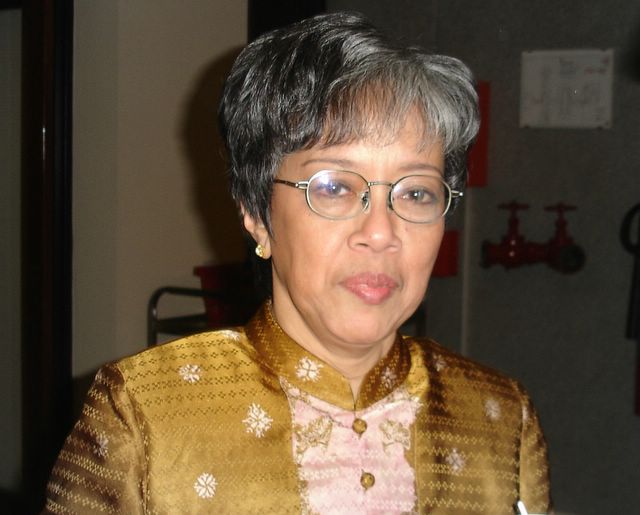
Indra Titus - Head of Radio Netherlands Indonesian Dept retires today. Busy with several projects in the aftermath of the Tsunami disaster. Posted by Hello

Tuesday, January 11, 2005

Apple's Shuffling


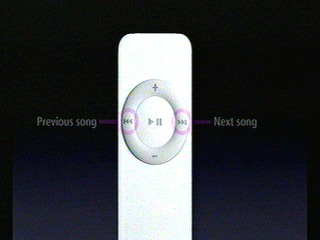
Do the Shuffle? Apple just announced they are shipping the i-pod Shuffle...about the size of a memory stick. The controls are simply play/pause, previous/next, volume up/down because there is no display. You connect it to your laptop with a USB 2 connector. US$ 99 for 512 MB, US$149 for 1 GB, so size comes at a big price. My playlist on the regular size Ipod is too big to Shuffle. Great news for some, not for me though.

Apparently, investors appeared also unimpressed with Jobs' announcements.

Apple's shares fell $2.71 to $66.25 during Tuesday's trading on the Nasdaq Stock Market.  Posted by Hello

Sunday, January 09, 2005

New rules for Commercial Radio in the UK

In mid December 2004, Ofcom published the first stage of its proposals for the development of a new framework for commercial radio in the UK. The proposals, which draw on dialogue with the radio industry, audience research and financial analysis of the industry, are intended to support moves towards greater choice for listeners and what is termed "less intrusive" regulation of the commercial radio sector.

The review is structured into two main phases. Phase 1, published on December 15th, addresses the immediate priorities required by statute whilst also putting forward for public consultation a number of potential options for the future. Phase 2, which will be published in the spring of 2005, will aim to reach conclusions on a broad number of issues of interest to the radio industry as a whole.

Facilitating the Growth of Digital Radio

Digital radio offers significant benefits to both broadcasters and listeners, including greater choice, enhanced services such as on-screen programme information, ease of use and reduced audio interference. Ofcom is seeking views on a number of potential options for digital radio, including:

* Allocating three more blocks of spectrum in VHF Band III to complete the coverage of DAB local digital radio throughout the UK .
* Proposing to raise the current 20% limit on the use of DAB digital radio multiplexes for non-programme related data such as multimedia downloads. This would require approval from the Secretary of State for Culture, Media and Sport.
* Replacing specific requirements about audio bit-rates for DAB digital radio services with a system of co-regulation to define audio quality standards which meet audience expectation.

Ofcom also seeks the views of industry and the public on the likely demand for additional nationally-allocated spectrum for DAB , whilst recognising Digital One’s investment in digital radio as the current commercial national radio multiplex licensee.

Further Development of Analogue Radio

Ofcom is seeking views on the allocation of 10 medium wave frequencies, each of which could be re-used in more than one area, for new community radio or local/regional commercial services.

The Regulation of Formats and Localness an Analogue Commercial Radio

Ofcom proposes to adopt a less intrusive approach to the regulation of local analogue commercial radio. This would involve a shift away from a focus on the mechanisms by which programming is produced (known as input regulation) and towards a greater focus on the experience of the listener – or output regulation.

Commercial radio stations operate according to an agreed specific format – a formal regulatory document summarising the station’s character of service, key programme promises and target audience. Ofcom proposes to require commercial stations to demonstrate adherence to their specific formats. It also proposes to use its new localness guidance, where appropriate, to regulate the local aspects of a station’s programming.

Ofcom is also considering changing regulation in the following areas, consistent where possible with a greater focus on the quality of the listener's experience and less focus on the detailed means of production:

* Studio Location. Ofcom proposes to relax the requirement for a station’s studios to be located within its Measured Coverage Area (MCA), allowing them instead to be based within the station's wider licensed area.

* Automation: Many stations now use elements of computer-controlled programming, such as music playout systems, voice tracks, drop-ins and commercials, which are played in accordance with a pre-defined schedule and which are not under the direct control of an on-air presenter. Ofcom is seeking views on the removal of all specific limits on the use of automation.

* Networking. This is defined as the transmission of the same programme at the same time across a number of interlinked but separate stations. The review will clarify that Ofcom will allow the networking of programming outside each station's locally-made programming requirements as specified in its respective Format.

* Local News Delivery: Ofcom wants to consider the case for allowing a group of local stations to operate a central news hub, distributing news material from the centre that is of interest to the separate audiences of each station. However, Ofcom also proposes that each station should maintain a local journalistic presence to ensure that the use of news hubs would not be to detrimental to the provision of a high quality local radio news service.

Ofcom proposes to introduce a new system of self-reporting which will require all stations to maintain a file stating the extent to which they have complied with their respective format and localness requirements. The file should be made available to the public on both the station’s website and in hard copy on request. Ofcom will carry out spot checks on compliance and will also investigate complaints from listeners and competitors.

Ofcom Chief Executive Stephen Carter said: "Radio is a dynamic medium at an interesting point of development."

He added: "These proposals seek responses to the prospect of more digital spectrum and a new approach to content regulation."

The closing date for comments on ‘Radio – Preparing for the future’ is 7 March 2005 .
Friday, January 07, 2005

Tampere Convention on Emergency Telecommunications Comes Into Force

Victims of disasters will now be able to benefit from faster and more effective rescue operations, thanks to the Tampere Convention on the Provision of Telecommunication Resources for Disaster Mitigation and Relief Operations that finally comes into force tomorrow, Saturday, 8 January 2005, following ratification by 30 countries. Until now, the trans-border use of telecommunication equipment by humanitarian organizations was often impeded by regulatory barriers that make it extremely difficult to import and rapidly deploy telecommunications equipment for emergencies.

Disasters are considered to kill one million people each decade and leave millions more homeless. When disaster strikes, communications links are often disrupted; yet for disaster relief workers who arrive on the scene these links are essential. Questions that require information gathering for immediate response include: how many people have been injured or have died, where the injured are located, where they should be dispatched and the extent of the medical help needed. As well, workers rely heavily on telecommunications to coordinate the complicated logistics of rescue and relief operations.

In the absence of an agreed multilateral framework that temporarily waives formalities, delays have meant the loss of lives. With this Convention, relief workers can make full use of today’s telecommunication tools which are essential for the coordination of rescue operations."

The Tampere Convention calls on States to facilitate the provision of prompt telecommunication assistance to mitigate the impact of a disaster, and covers both the installation and operation of reliable, flexible telecommunication services. Regulatory barriers that impede the use of telecommunication resources for disasters are waived. These barriers include the licensing requirements to use allocated frequencies, restrictions on the import of telecommunication equipment as well as limitations on the movement of humanitarian teams.

The Convention also safeguards the privileges, immunities and facilities granted to persons providing disaster assistance by granting them immunity from arrest and detention and exempting them from taxation and duties. As the first treaty of its kind, the Convention also defines the non-governmental organizations and non-State entities whose personnel would be granted these privileges and immunities when engaged in supporting the work of UN humanitarian and rescue organizations such as the United Nations High Commission for Refugees (UNHCR), OCHA and the International Federation of Red Cross and Red Crescent societies (IFRC).

The Convention defines the overall framework for the cooperation among States parties and all other partners in international humanitarian assistance. It describes the procedures for request and provision of telecommunication assistance, recognizing the right of a State party to direct, control and coordinate assistance provided under the Convention within its territory. It defines specific elements and aspects of the provision of telecommunication assistance, such as termination of assistance and settlement of disputes. It requires States to make an inventory of the resources — both human and material — available for disaster mitigation and relief, and to develop a telecommunication action plan that identifies the steps necessary to deploy those resources.

The Convention requires a requesting State party to the Convention to put in writing, prior to the arrival of telecommunication assistance in a disaster zone, the fees it expects to receive or have reimbursed. To avoid excessive charges, the fees are based on an agreed model of payment and reimbursement, as well as on other factors such as the nature of the disaster, natural hazard and the particular needs of developing countries.

In fulfilling the objectives of the Convention, the Operational Coordinator will seek the cooperation of other appropriate United Nations agencies, particularly the International Telecommunication Union.

The seventeen-article, legally binding international treaty, was unanimously adopted on 18 June 1998 by the delegates of the 75 countries that attended the Intergovernmental Conference on Emergency Telecommunications (ICET-98), hosted by Finland in Tampere, about 200 km north of Helsinki. The Treaty was then open for accession, requiring 30 ratifications to come into effect.

Clusty - Better than Google?

Writing and researching for a living, I make extensive use of search engines and have a low tolerance to rubbish. So I was intrigued when Colby Stuart passed on this clipping from Business Week Magazine.

Building a Smarter Search Engine

"Since its launch three months ago, Clusty has generated buzz for its clean design and clever approach. Using artificial intelligence, Clusty groups search results into different categories. The idea is to help people quickly navigate through the flood of results a general search engine lists without any organizing principle beyond popularity."


Been playing with Clusty for a few days, and I like the way it puts links into logical clusters. I found it a useful alternative to Google, but not a replacement. There were links that Google found that Clusty didn't - and vice versa. But definitely better than AltaVista and Lycos.

ShareThis