Snaps taken at the official inauguration of the monument to the PHOHI shortwave transmitter towers at 14 hrs UTC, Saturday 11th November 2006. Mayor of Huizen, F.W. van Gils, officially accepts the towers from the organising committee. Seems the project has taken 2 1/2 years and is a 1/5th scale model of the original. These were first, wooden, rotatable SW antennas in the world. The model is fixed as it would have stood for transmissions in the direction of Surinam. Rest of the photos are on Flickr.
Saturday, November 11, 2006
Official Handover of Two Towers
Snaps taken at the official inauguration of the monument to the PHOHI shortwave transmitter towers at 14 hrs UTC, Saturday 11th November 2006. Mayor of Huizen, F.W. van Gils, officially accepts the towers from the organising committee. Seems the project has taken 2 1/2 years and is a 1/5th scale model of the original. These were first, wooden, rotatable SW antennas in the world. The model is fixed as it would have stood for transmissions in the direction of Surinam. Rest of the photos are on Flickr.
Friday, November 10, 2006
NHK - bad sign
"We don't intend to influence programme content. Our purpose is only to repatriate abductees as soon as possible," Suga said. "We hope the public understand."
NHK Chairman Genichi Hashimoto told reporters after receiving the order from Suga at the ministry that the public broadcaster will "stick to its basics of independent and autonomous programme editing in its international broadcasting" just as in its other broadcasting services.
Article 33 of the Broadcast Law says the communications minister "may order NHK to conduct international broadcasting by designating areas of broadcasting, matters for broadcasting and other necessary matters".
This past Wednesday, the Radio Regulatory Council, an advisory panel to the communications minister, endorsed the order for NHK in a report after Suga asked it to deliberate on the mater earlier in the day.
The panel concluded that it is appropriate for the minister to tell NHK to be "specifically mindful of the problem of North Korea's abduction of Japanese" in the service, noting the need to take NHK's editorial freedom into consideration.
Sounds like pure government interference to me. And an incredibly stupid move. If the subject of abductees North Korea was being discussed in Japan (which it is), NHK would be covering that discussion as part of its normal journalistic work. It also seems bizarre that the order is only for the SW radio broadcasts, when NHK is putting far more money into its overseas TV operations, closing a number of radio services next year.
Governments make bad radio programmes. Journalists make lousy politicians. Keep it that way.
We're banned in China
Wednesday, November 08, 2006
The Two Towers

Yep, jokes already coming my way that I live in the city of Two Towers now (see below). Seems the towers will be officially blessed by the mayor this Saturday. They are 12 metres high, but seem higher, perhaps because they're wider than the average lampost. Seems the initative was taken by the people behind the local radio station here, also called Radio Phohi, 105 FM.
Tuesday, November 07, 2006
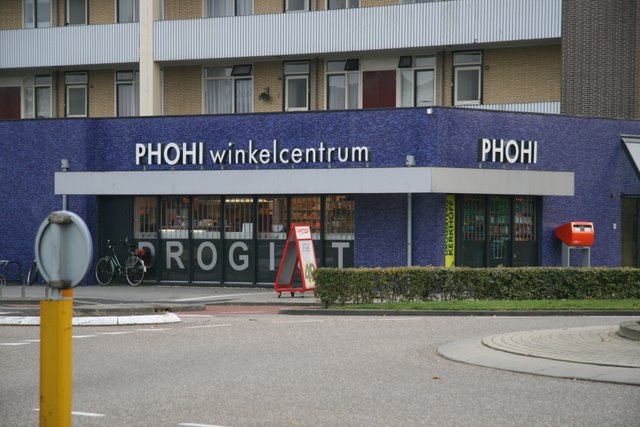
PHOHI Flats & Shops
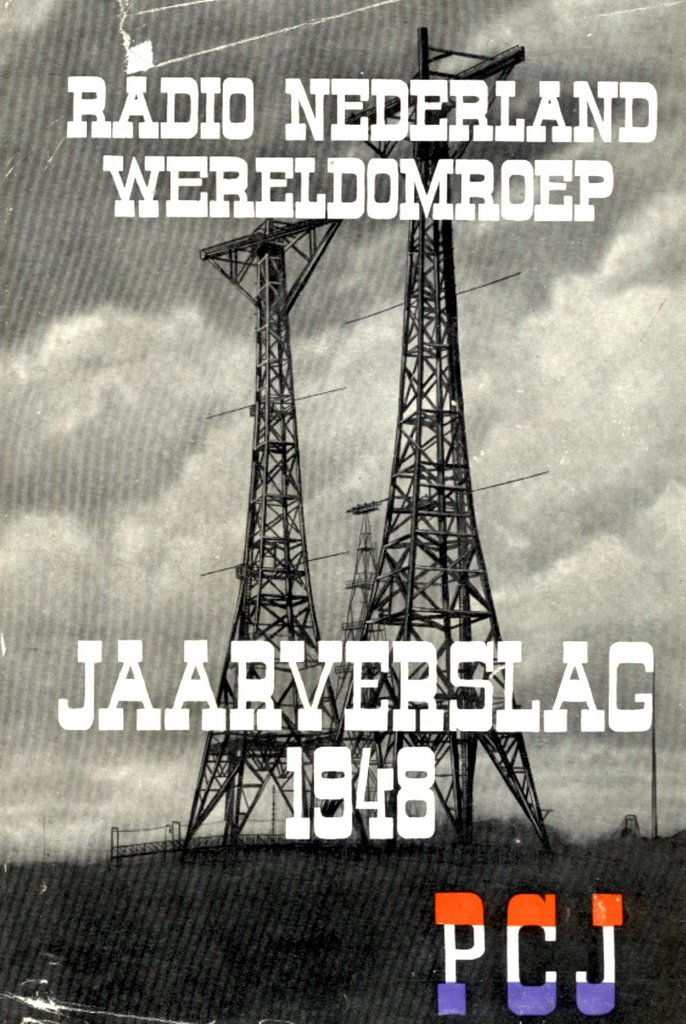
Just down the road from the monument are the Phohi flats and shops. Until now, the only monument to the fact that transmitters once stood there has been an inscription in the stairwell of the flats...most people haven't a clue about what it means. If you speak Dutch, then this page has some of the best stories and photos. PHOHI stood for Philips Omroep Holland Indie, which meant Philips broadcasting (service) for Netherlands Indies, i.e. the empire. The signals could be heard in the Caribbean as well as in Indonesia. Those were for commercial programmes in Dutch in 1937-1940. There was also a special programme on Sundays in English and Spanish which was given the callsign PCJJ, which presenter Eddy Startz shortened to stand for Peace Cheer and Joy. It was international entertainment for its day.
New Shortwave "Transmitter" Roundabout in Huizen
So there I am, driving along the Randweg, a road on the southern side of the my home town, Huizen, in the Netherlands.
I came up to a roundabout that has been recently renovated and what did I see? A fifth-size replica of the world's first rotatable shortwave transmitting tower....slap bang in the middle of a new roundabout. Went back home to get the camera...just couldn't believe it. It was made of wood and stood on a site about 300 metres from the roundabout between 1937 until 22nd September 1958 when it was blown-up. Seems it took four attempts to knock the 63 metre high masts over. A new, more powerful site in Lopik, near Utrecht took over the transmissions of what was, by then, Radio Nederland Wereldomroep. The scale-model is just over 12 metres high.
As I was filming this new monument, I got mixed reactions from passers by. Some seem to be dead against it, probably because they hadn't a clue what it was. Some older folk, born and bred in this fishing village, were kinda proud of Huizen's link with the past. One kindly old gent offered to show me a set of old photos he'd kept. Another lady remember playing in the masts in 1958 when the towers were awaiting demolition. She also recalled how the turntable used to make a strange squeal like wheels on a railway engine as it spun round late in the afternoons and at night. The antenna strung between the masts was directional. By rotating it, the signal could be beamed in different directions, mainly to Asia, Africa and North America. The antenna, I believe, was actually tuned to a single frequency in the early days, 9590 kHz in the 31 metre band.
More pictures on my Flickr pages.
Thursday, November 02, 2006
Think we just had autumn today
Toyota Prius Hybrid
BMW slump
Don't agree with the last sentence. I think BMW needs to take a serious look at its customer care system in the Netherlands. Once you walk out of the showroom, neither the dealer nor BMW lease treat you as a person. You are a licence plate number. I got invitations to buy a new car within months of getting a Model 3 in 2002. In fact, all the promotional material was out of sequence. They don't make you feel special at all. My decision to switch came when I got a flat tyre on a motorway. I stopped just outside a BMW dealership on the edge of the motorway ramp. Both the automobile club and I were astonished to discover the BMW dealer wouldn't assist because the car wasn't purchased there. I got drenched and missed an important flight. Never, Never again.
Just taken delivery of a Toyota Prius Hybrid car. Amazing piece of technology under the hood.
Wednesday, November 01, 2006
BBC WS - How many languages?

I have made comments in this blog of the uneven nature of BBC World. Watching the "raw feed" in many parts of Europe is very difficult - programmes are continually interupted for non-existant commercial breaks and an automated programme info sequence wows in, often in mid sentence. BBC World has some great programmes of its own, like Click and Hard Talk. But when you see a programme promo for a programme that has just finished, then you wonder who is looking after channel continuity. The BBC World website is also only partially updated. Checked the links page this evening to see that BBC World Service radio is still broadcasting in 43 languages. Nope, it has been 33 for nearly a year now.
Sunday, October 29, 2006
Winter Time Out of Step Again in 2007?
So more headaches for airline planners and international broadcasters I guess.
Friday, October 27, 2006
Yikes, Windows Error on Rome Departure Terminal
Originally uploaded by Jonathan Marks.
For my horror collection of Windows error screens. Always makes me a little nervous.
Day 3 : Possible Next Steps Towards WCCD 2.0
Brochure Chaos - the competition for attention
Originally uploaded by Jonathan Marks.
Today, the final day of WCCD, a lot of time has been spent on trying to come to some final statement or consensus. For most of us, it is clear that broadcasters, IT, donors and development agencies are going to need to work more closely together. Jargon and a lot of competition between agencies in the development world will take some getting used to.
Here are my observations and suggestions for how to move forward after the excellent World Congress on Communication for Development.
The goal was to lay the foundations to ensure communications becomes a central pillar for development projects, rather than an after-thought. In that respect, I think it was a great first step. The fact that the organizers brought together a broad cross-section of practitioners made it interesting for me. Everyone brought a different set of perspectives and disciplines. In total there were 24 thematic sessions, 13 special events and 680 participants, policy makers, academic, grass roots organizations. The log shows around 140 journalists were covering the event. If anyone found it boring, then they came for the wrong reasons.
What did the conference achieve?
Although there was a Rome Consensus issued at the end of the conference, the biggest benefit was the cross-disciplinary exchange between people really on the ground. Too many politicians would have confused the discussion. The idea of having Nobel prizewinners attending was much better. The best speakers had plenty of real-cases to share – especially advice on what works and didn’t work. The fact that people were willing to share their mistakes was a bold move for a conference like this.
The fact that many directors of aid agencies and donors were present was great. I am sure it was an eye-opener for many. Unless they implement policy from the top, it will never empower the ideas coming from the bottom-up.
What needs to happen next?
1. Ideally, we would see a series of regional discussions involving the same broad-cross section of people. These meetings would focus on ways to pull communications higher up the agenda of priorities, especially the communication between agencies on the ground and the people they are trying to assist. But the context and methods to do this are very different depending on where you are. Especially in Africa, there are huge differences even within a region like West Africa.
2. The next phase of regional meetings would start as on-line discussions (using wikis, blogs, and other social software tools) and then turn into a face-to-face meeting. The conversations should have a longer lifetime than the few days when people meet each other. Active participation can be rewarded in the form of grants to meet colleagues face to face.
3. More sharing of good practice (and things that didn’t work) would be extremely useful. I realize that some agencies are concerned that if they share their mistakes, journalists present may create negative publicity in the search for a story. But my experience was that people were willing to be far more candid than I expected - in the workshops rather than in the plenary sessions. In 2-3 years time, there will be enough case studies to make a global meeting like in Rome worthwhile. People learn more from role models with practical stories to tell. It would also be great to hear stories of how partnerships have held up – and what can be done when, inevitably, they come under strain. Does 1+1 always have to equal 2.5? These stories should fit on a few sides of A4. Everyone in the conference was allergic to 50 page justifications which hit the dustbin at airports when you’re trying to go home.
4. I didn’t hear anyone disagree with the premise that communication is essential for any country’s development. How and when that is done needs more study. It is clear to me that ICT and broadcast are rapidly becoming areas where there is overlap. No broadcast station can survive without ICT – it is an essential production and aggregation too.
5. Radio (especially) and TV provide the point to multi-point contact with the community. The clever organizations use such tools to be a catalyst for a conversation inside that community. Broadcasting is not shouting a message – it is finding ways to share it. Broadcasters are becoming more content production houses. There are now plenty of examples of cross-media concepts, where a combination of radio, TV, mobile and web is making a more effective mix.
6. Just as there are different ways of communicating inside a community, so there are different phases in the lifetime of a communications plan. Communication to raise funds and awareness in donor countries is a completely different stream to the task of communicating in the area where an agency is active. And the communications plan for helping immediately after a disaster should go through several distinct phases as time progresses. Otherwise, as people pick up their lives, the information flow does not adapt to their changing needs.
7. Broadcasters also need a clear “exit strategy”, showing at what point they will trust the people they have trained. I heard several complaints about how foreign broadcasters/NGOs were now distorting local markets because their initial goal had been fulfilled. Local broadcasters also need help in working on realistic business models, with or without sustained subsidy. Each solution will depend on the local context.
8. Aid agencies also need to understand how to work with the commercial media sector. In many countries, there is an assumption that the local public/state broadcaster is the natural partner for NGO’s. In some countries, the market share of the government broadcaster has dropped to an all time low – often because of a lack of press freedom and/or transparency. Commercial broadcasters, on the other hand, have a completely different business case immediately after a disaster, when 50-100% of their advertising revenue goes away.
9. The media studies currently being done by various agencies (USAID, BBC World Service Trust to name a few) will be extremely useful in making more practical communications plans. Hopefully, they will be in the public domain.
10. Content is important. But so is the context. Each concept needs to be adapted to fit the cultural context. And the future is broader than broadcasting – what happens in a country with radio and TV is becoming closely linked to a country’s policy on Internet and mobile telephony. It is very important that people think sideways.
11. The community radio sector needs to provide more documented cases of why rural radio can empower a community. Many of the presentations I saw were too defensive and concentrated on how they had built a station and what they were doing with the money. Working from the premise “this community does not need a radio station unless….” is a better starting point.
12. Donors need to have a clearer understanding of the costs involved in making useful, interesting content. Many regional/local stations in Europe cannot produce community news/current affairs programmes without a subsidy from regional or national government. Yet, many donors believe it is possible to do the same in remote parts of Asia, Latin America and Africa. Often, locals come up with ingenious ways of working towards sustainability (acting as a communications hub for the village, offering SMS market info, having shares in mobile phone companies). May be the World Bank can offer prizes to reward those with the best business plan that has been shown to work?
13. Convergence is creating new professions. One emerging profession is the development communicator – someone who understands how the development/donor industry works and has journalistic skills to understand the context in which stories need to be told. You need an overview of the various communication channels emerging in developing countries and how they can interact. That means you need to look sideways as well as forward. I know of no institution that is training in this way. The World Bank and/or Communication Initiative could be a catalyst in this respect – convening rather than doing the training themselves.
14. Practical Point; Make sure that workshop sessions are held in a room with chairs in a circle, not a lecture theatre. The round-table encourages people to see others as equals and it is much easier to communicate. The role of the chairperson is much easier too, as he or she can drive the discussion much better when they are not up on a stage. I thought the quality of discussion after the presentations was better in rooms with a forum layout.
Tape Recorder Collection
Originally uploaded by Jonathan Marks.
Spent a few hours this morning at the radio museum inside the Vatican Gardens. Filmed a lot of very interesting equipment which forms part of a collection of the last 75 years of Vatican Radio. Check out more shots on my Flickr pages. They are actually stills from a HD camera....actually rather pleased the way they turned out.
Thursday, October 26, 2006
Strolling past the Colosseum
Rome Colosseum
Originally uploaded by Jonathan Marks.
Buses left the FAO to take people back to the out-of-town hotel and then on to a gala buffet back downtown. Since, I wasn’t going to spend 2 hours on a bus just to change a tie, I wandered the 20 minutes from the FAO past the Tomb of the Unknown Soldier to the Palace. It is still remarkably warm for this time of year. Great talking with fellow participants from the Economist and Open Media.
Community Radio Monologues
Community Radio Discussion
Originally uploaded by Jonathan Marks.
I went along to a session today on community radio. Held in the Mexico room, it was actually overstuffed with people. It was a shame that the people from AMARC, the world association of community radio, just talked about what they are doing, rather than why they are doing it. There was no real discussion of why community radio was not specifically mentioned in the final “Rome Consensus Draft version”. AMARC Africa’s current management problems didn’t come up, although the crisis is well known amongst donors. AMARC needs to show the clear business case as to why radio is so powerful in keeping communities talking with each other. To quote Bush Radio’s Zane Ibrahim, the best stations are 90% community and 10% radio – not the other way round. I get the impression few community stations are doing follow up research on their effectiveness.
AMREF Student Reporters at WCCD
Originally uploaded by Jonathan Marks.
Camera man films camera man. He has a better mike than I do. And a much bigger smile!
AMREF Student Reporters at WCCD
Originally uploaded by Jonathan Marks.
The African Medical & Research Foundation is training former street children in Nairobi to express themselves with video diaries. They were having the time of their lives - and asking very searching questions. Hope we get to see the final results.
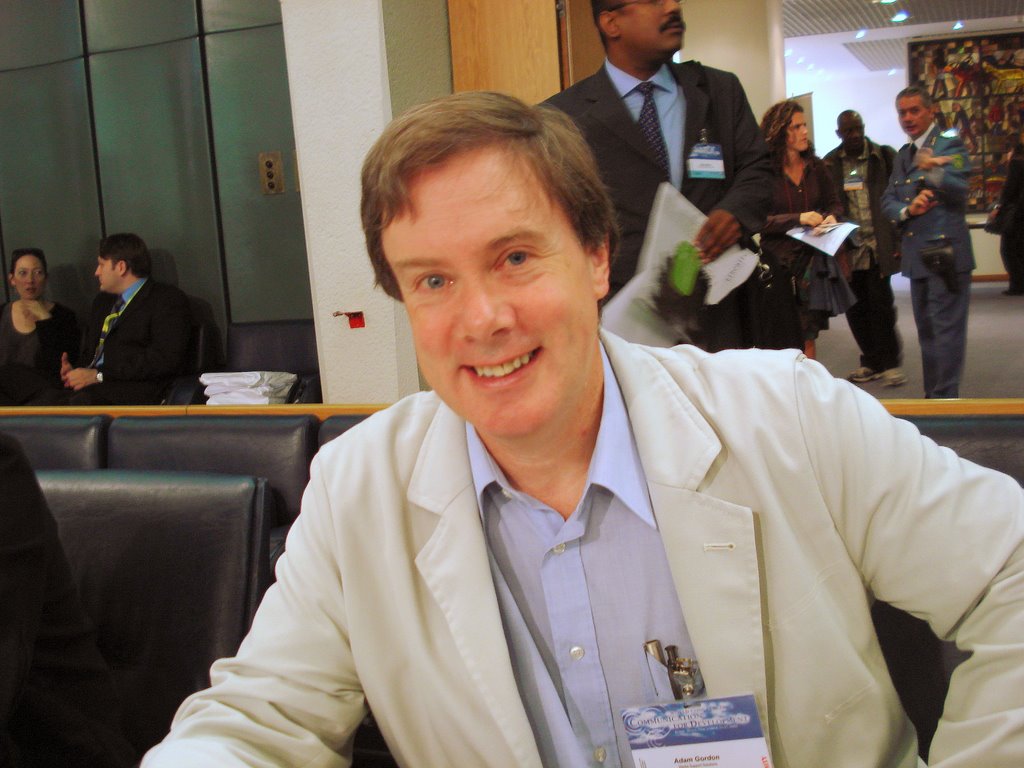
Gordon Adam

Great to meet Gordon Adam this afternoon, formerly BBC and now in the broadcast consultancy business, especially in developing countries. He runs Media Support out of an office in North Kessock, Rossshire in Scotland. He's just back from Afghanistan.
Gordon made an interesting contribution to several sessions and submitted a paper on the problem facing this part of the industry.
It is very difficult to find people who are suitably qualified for this type of work in communication for development. Journalists don’t understand development nor do they have the patience to grasp the research methods needed to show long term effects. Development people don’t understand how to communicate and the gang PR go for the hard sell which may work on the short term, but not in the long. The aid agencies understand how to communicate to donor countries to raise funds, but not how to organize camapaigns to help locals who are affected by disaster.
Many of the development agencies do not understand the skill set required to do this kind of job. They don’t want to hire people straight from university because they don’t have any field experience. The aid agencies need to hire more people with practical journalistic experience. There are so few universities that offer courses in this combined skill set.